Detailed operating model
Look up every route, skill, and stop code across the four stages, and who runs and decides each one.
Use this page to find the exact route through a stage, the order of its skills, and where the agent stops for you. For the four stages at a glance, see the Operating model.
The map
Section titled “The map”Select the map to open it at full size.
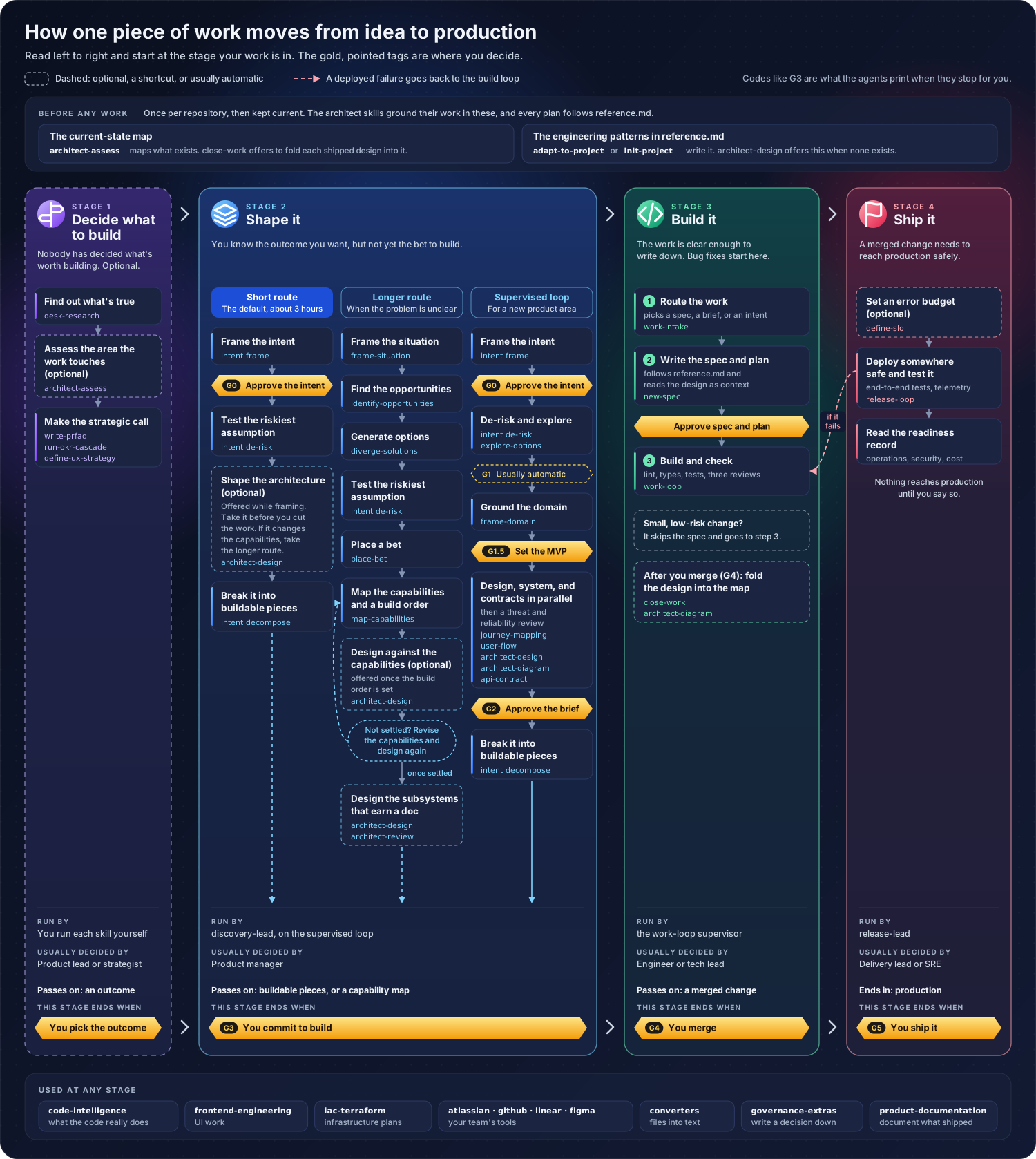
Before any work
Section titled “Before any work”Once per repository, then kept current. architect-assess maps what exists, and close-work offers to fold each shipped design into that map. adapt-to-project or init-project writes reference.md, the file that names your stack and standards, and architect-design offers this when none exists. Every plan follows reference.md.
Stage by stage
Section titled “Stage by stage”Dashed boxes on the map are optional, a shortcut, or usually automatic. A gold, pointed tag is where you decide, and its code, such as G3, is what the agent prints when it stops for you.
- Decide what to build (optional).
desk-researchfinds out what is true. If the work touches a system that already exists,architect-assesscan assess that area first.product-strategythen makes the strategic call withwrite-prfaq,run-okr-cascade, ordefine-ux-strategy. You run each skill yourself, and a product lead or strategist usually decides. The stage ends when you pick the outcome. - Shape it, by one of three routes. Each ends at G3, when you commit to build, and passes on buildable pieces or a capability map. A product manager usually decides.
- Short route, the default, about three hours:
intent frame, then you approve the intent (G0), thenintent de-risktests the riskiest assumption. While you frame,architect-designis offered to shape the architecture. Take it before you cut the work, and if it changes the capabilities, take the longer route.intent decomposebreaks the work into buildable pieces. - Longer route, when the problem is unclear:
frame-situation,identify-opportunities,diverge-solutions,intent de-risk,place-bet, thenmap-capabilitiesfor the capabilities and a build order, thenintent decomposetakes the capability map as input. Once the order is set,architect-designis offered to design against the capabilities. If the design is not settled, revise the capabilities and design again. Thenarchitect-designdesigns the subsystems that earn a doc, andarchitect-reviewchecks them. - Supervised loop, for a new product area, run by
discovery-lead:intent frameand G0, thenintent de-riskandexplore-options. G1 usually passes on its own.frame-domaingrounds the domain, and you set the MVP (G1.5). Design, system, and contract work run in parallel withjourney-mapping,user-flow,architect-design,architect-diagram, andapi-contract, then a threat and reliability review. You approve the brief (G2), andintent decomposebreaks it into buildable pieces.
- Short route, the default, about three hours:
- Build it, run by the work-loop supervisor. An engineer or tech lead usually decides.
work-intakeroutes the work to a spec, a brief, or an intent.new-specwrites the spec and plan, followingreference.mdand reading the design as context, and you approve both.work-loopbuilds and checks: lint, types, tests, and three reviews. A small, low-risk change skips the spec. The stage ends at G4, when you merge. After the merge,close-workandarchitect-diagramfold the design into the current-state map. - Ship it, run by
release-lead. A delivery lead or SRE usually decides.define-slosets an error budget if you want one.release-loopdeploys somewhere safe, then runs end-to-end tests and watches telemetry. A failure goes back to the build loop. You read the readiness record on operations, security, and cost, and the stage ends at G5, when you ship it. Nothing reaches production until you say so.