Operating model
Know which stage your work is in, which packs help there, and where the agent waits for your decision.
Every piece of work moves through four stages: decide what to build, shape it, build it, and ship it. Agents do the work inside each stage. Each stage ends with a decision a person makes.
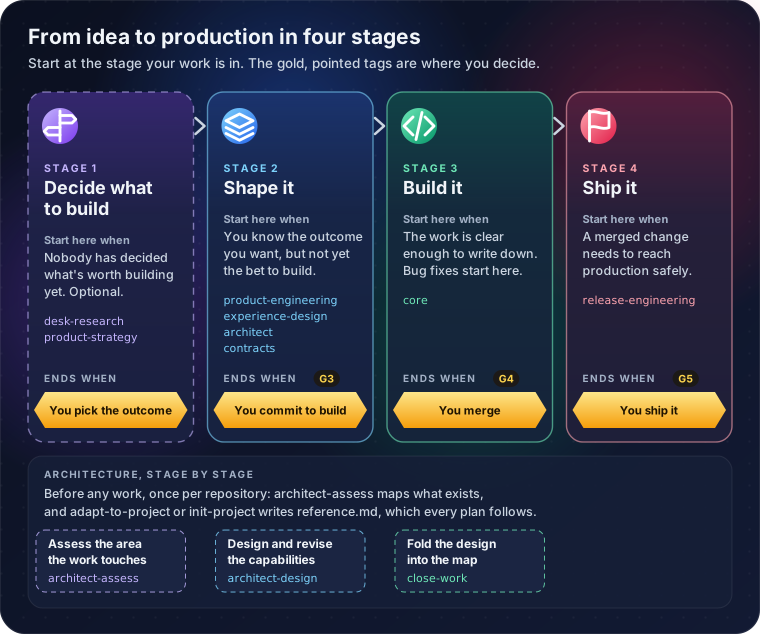
See the detailed operating model for every route, skill, and decision.
The four stages
Section titled “The four stages”Start at the stage your work is in. A bug fix starts at Build it.
| Stage | What happens | Packs | It ends when you |
|---|---|---|---|
| Decide what to build | Gather evidence and make the strategic call | desk-research, product-strategy | Pick the outcome |
| Shape it | Frame the idea, test the riskiest assumption, design it, cut it into pieces | product-engineering, experience-design, architect, contracts | Commit to build |
| Build it | Write the spec, build, run the checks, review | core | Merge |
| Ship it | Deploy to a throwaway environment, test it, watch it run | release-engineering | Ship to production |
Some packs help at any stage: code-intelligence to learn what the code does, governance-extras to record a decision, product-documentation to document what shipped, and atlassian, github, linear, and figma to connect your team’s tools.
Decide what to build
Section titled “Decide what to build”You find out what is true, then choose what to bet on. desk-research answers questions with sources and a confidence rating for each finding. product-strategy turns the picture into a direction, such as a SWOT (strengths, weaknesses, opportunities, threats), goals cascaded to teams, or a press release written before the product exists. See Research a question and Set direction and goals.
Shape it
Section titled “Shape it”You turn the outcome into work the build can take. There are three routes, and all end when you commit to build:
- Short. Write the intent, test its riskiest assumption, and break it into pieces. Most teams start here.
- Longer. Map the situation, the opportunities, and the options before you bet. Use it when the problem itself is unclear.
- Supervised. The
discovery-leadagent runs product, design, architecture, and contract work side by side, and two reviewers check threats and reliability before you see the brief. Use it for a new product area.
See Shape an idea.
Build it
Section titled “Build it”The core pack’s work loop builds the piece: features, fixes, refactors, migrations, and upgrades. Small, low-risk work runs straight from your request. Riskier work gets a written spec and plan, which you approve before any code is written.
Lint, type checks, and tests must pass: the agent cannot report success while one fails. A shaping review checks the spec before code starts, and three reviewers then read every change cold: an adversarial reviewer for drift between spec and code, a security reviewer, and a quality reviewer. The merge is always yours. See Run the build loop.
Ship it
Section titled “Ship it”The release-engineering pack deploys the merged work to a throwaway environment, runs end-to-end tests, and watches its live metrics until it meets the targets you set. A failure goes back to the build loop as a task. It never touches production: you read a short report on how ready it is and decide whether to ship. See Release a change.
Where the agent waits for you
Section titled “Where the agent waits for you”The more permanent the action, the more the agent waits:
| What happens | Examples | The agent |
|---|---|---|
| Can be undone | Exploring options, writing and running tests, deploying to throwaway environments | Keeps going |
| Needs a call | A blocker, or the release loop reaching its stop point | Stops and shows you where things stand |
| Can’t be undone | Committing to build, merging, shipping to production | Waits for your yes |
When an agent stops for a decision, it labels the decision point with a short code:
| Decision point | You decide |
|---|---|
| G0 | Is the problem real, and worth a bet? |
| G1.5 | What is in the first version? Shown only on the supervised route. |
| G2 | Is the brief good enough to build from? |
| G3 | Is it ready for the build loop? |
| G4 | Is the merged change ready for release testing? |
| G5 | Does it go to production? |
Where architecture comes in
Section titled “Where architecture comes in”Before any work, the architect-assess skill maps the system you have, and adapt-to-project (for an existing codebase) or init-project (for a new one) writes reference.md, the file that names your stack and standards. Every plan follows it.
After that, architecture joins each stage when it is needed: you assess the area a bet touches while deciding, design against the capabilities while shaping, and change the design in the open if the build proves it wrong. After the merge, close-work offers to fold the shipped design back into the map. See Design the architecture.
Why three loops
Section titled “Why three loops”Working out what to build, building it, and shipping it are different jobs. Exploring five product ideas is cheap and a bad release is not, so each job runs in its own loop with its own checks: discovery-lead for shaping, the work loop for building, and release-lead for shipping. None runs inside another, and nothing crosses from one to the next without your decision.
Where each loop installs
Section titled “Where each loop installs”Each loop installs where its work happens. Shaping happens in documents, so it installs for you; building and shipping happen in the repository, so they install there:
agentbundle install --pack product-engineering --scope usercd path/to/your-repoagentbundle install --pack coreagentbundle install --pack release-engineeringInstall only the loops your team uses. Most teams start with core.